
A California City Is Fining a Man $1,250 and Counting for Growing Food on His Own Land
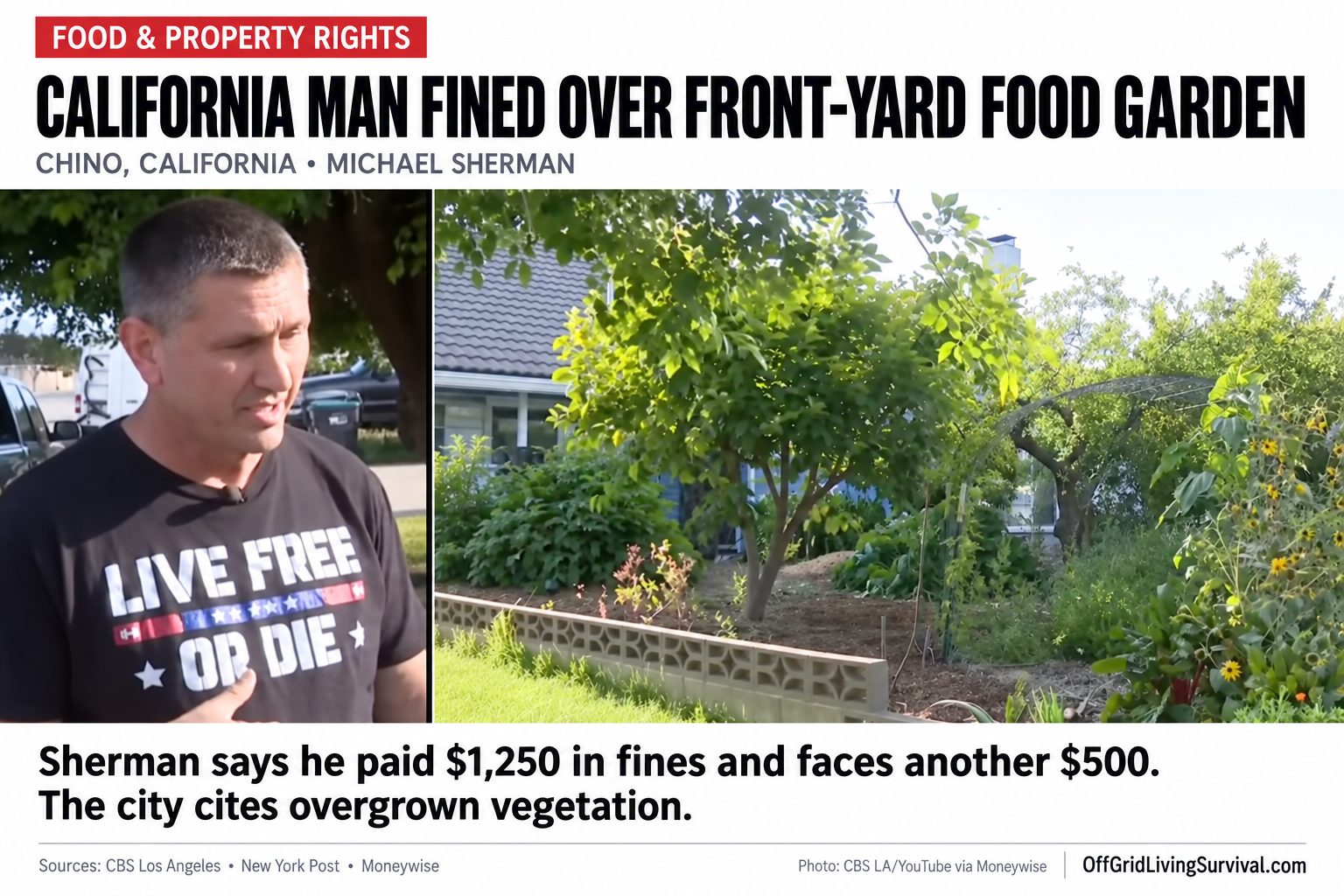
Michael Sherman did everything the off grid community preaches. He tore out a useless lawn, put in food, cut his dependence on a supply chain he doesn't trust, and fed his family from his own dirt. The City of Chino, California, has answered with three citations, $1,250 in fines paid so far, another $500 hanging over his head, and a code enforcement office that won't even tell him which plants are the problem.
This is not a story about one guy and one yard. This is what happens to anyone who tries to take real responsibility for their own food inside city limits in most of America.
What Chino did
Sherman, 49, is a landscape contractor. In 2019 he replaced his front lawn with what he calls a Food Forest: sweet potatoes, squash, ginger, turmeric, horseradish, bananas, sugar cane, plums, peaches, blueberries, passionfruit, radishes, Swiss chard, sunflowers, aloe. He started because he was hearing about food shortages and didn't want to bet his family's dinner on somebody else's truck showing up. His words to the press: he doesn't trust the food system, he wants vegetables he knows haven't been sprayed, and he wants to get as close to feeding his family off his lot as a small lot allows.
For seven years the garden grew. His next-door neighbors say they've never had a problem and that he's constantly handing them produce. Then one complaint landed.
In April 2026 the city hit him with $750 in fines for "overgrown vegetation" and handed him three demands: remove all overgrown vegetation, maintain a line of sight, and keep crops from growing within 15 feet of the neighboring yards.
Sherman complied. He pulled bushes, cut back growth, trimmed trees. He publicly agreed the sightline rule made sense for pedestrian safety.
The city fined him again anyway. Another $500, paid September 2. Another $500 due if he isn't "compliant" by September 16. A city spokesperson told CBS the violations will continue until he removes or trims the remaining overgrown vegetation. When Sherman asked which plants specifically, he says they wouldn't tell him. Some of what they're apparently objecting to are annuals that are going to die off on their own in a few weeks.
Read that again. The government is fining a man for plants that will be dead before the next citation, and won't say which ones.
The math of "compliance"
Here is what the city has extracted from a taxpayer for the crime of growing dinner:
- $750, April 2026
- $500, September 2, 2026
- $500 pending, September 16, 2026
- Total exposure so far: $1,750
That is before his time, the cost of hiring help to rip out mature fruit trees, the appeal he now has to fight, and the produce he'll lose. He was growing food to save money on groceries. The city has now made his garden more expensive than the grocery store. That is the entire point of the fine schedule. It is not designed to fix a problem. It is designed to make you quit.
And notice what the enforcement mechanism is. Not a hearing first. Not a written standard he can measure against. A complaint from one person, a subjective judgment by one inspector, a fine, and then a rolling series of fines with no defined finish line. "Overgrown" is whatever the inspector says it is on the day he drives by. You cannot comply with a standard nobody will write down. That is the trap, and it is deliberate.
The pest excuse doesn't survive contact with the city's own demands
The public justification for all this is rodents. One neighbor told CBS she's "worried about rodents" and that the yard isn't always kept up. Not that she's seen rats. That she's worried about them. Nobody, including the city, has produced evidence of an actual infestation. The next-door neighbors on both sides say they've never had an issue.
Now hold the city's three demands up against what the actual public health experts say. Los Angeles County's Department of Public Health publishes rodent prevention guidance for yards. It says to clear fallen fruit, thin ground cover, keep a foot of open space at the base of shrubs, and keep tree limbs at least four feet off structures. On spacing between properties, the county recommendation is roughly six feet.
Chino demanded 15. More than double what the health department says is needed to stop rats from moving yard to yard.
And "maintain a line of sight" does nothing for rodent control at all. Rats do not care whether a pedestrian can see across your lawn. That demand exists for one reason: so the yard looks the way the city wants it to look from the street.
So the city took a public health concern with no evidence behind it, wrote demands that exceed the health department's own guidance, then added a requirement that has nothing to do with health at all. That is not pest control. That is an aesthetic ordinance wearing a pest control costume, and the costume is the only thing that lets it survive a challenge. Meeting all three demands, by Moneywise's own read of the case, would make it significantly harder for Sherman to grow food the way he does now. Which was always the goal.
"But there's a law for that"
California passed the Neighborhood Food Act, AB 2561, back in 2014. It's held up nationally as the gold standard for protecting home food growers. Here's what it actually does: it voids HOA rules that unreasonably restrict personal agriculture, and it forces landlords to let tenants grow food in containers.
Here's what it does not do: bind cities.
The original bill as introduced in February 2014 included a section that would have blocked cities and counties from restricting personal agriculture in residential zones, allowing only narrow, reasonable rules about dead plant material and the like. That language did not survive. The version signed into law covers landlords and HOAs and stops there. Municipal code enforcement was left completely untouched.
So Sherman's HOA reportedly approved the garden in writing years ago. Doesn't matter. The city isn't the HOA. The city can do whatever it wants under "overgrown vegetation," and the state's celebrated food freedom law is worthless against it.
Florida did it right. After Miami Shores spent years fining Hermine Ricketts and Tom Carroll for a front yard vegetable garden, and after the courts sided with the city, the legislature stepped in and passed what is now Florida Statute 604.71. It flatly prohibits local governments from regulating vegetable gardens on residential property. California never closed that door. Chino is walking right through it.
The property rights problem nobody wants to say out loud
The Fifth Amendment says private property shall not be taken without just compensation. The Fourteenth says no state shall deprive any person of property without due process of law. Most people assume that means the government can't dictate what grows in your yard.
It doesn't mean that anymore, and you should know exactly why.
Courts review local land use and "aesthetic" ordinances under rational basis, the weakest test in constitutional law. If a city can articulate any conceivable reason for a rule, it stands. "Neighborhood character" counts. "Pests" counts, with no evidence required. That is why Ricketts lost in Florida even though she had grown vegetables for seventeen years without a single incident. The judge didn't rule her garden was harmful. The judge ruled the city was allowed to think it might be.
That is the state of your property rights inside city limits in 2026: you own the dirt, the city owns the decision. The Constitution's text is on your side. The case law is not. The only things that have reliably worked are state preemption laws like Florida's, and organized, loud, sustained public pressure that makes fining a food garden politically radioactive.
Why this matters to anyone going off grid
Off grid does not start when you buy land in the desert. It starts the day you decide to stop outsourcing your survival. Food is the first and most basic system, and it is the one local governments police hardest because it is visible from the street.
Sherman's case is the same fight as every other one you hear about:
- Rainwater collection banned or permitted to death
- Composting toilets and greywater systems criminalized under plumbing codes
- Minimum square footage rules that make a small cabin illegal to live in
- "Unpermitted structure" citations on chicken coops and greenhouses
- Mandatory utility hookups that make it illegal to disconnect from the grid even if your own system works
Every one of these is the same move. Take an ordinary act of self reliance, reclassify it as a code violation, and charge you until you either pay for permission or give up. The fine is the product. Compliance is the subscription.
And the trigger is almost never harm. It is a neighbor who doesn't like how it looks, and a code office that gets paid either way.
What to actually do
If you're in a city or suburb and growing food, here's the hard truth from Sherman's case:
Get the standard in writing before you get the citation. Ask code enforcement, in writing, what "overgrown" means in your municipal code. If they can't define it, that is your first exhibit.
Document everything. Sherman has photos from April and June showing the changes he made. That is why the story reads the way it does. Dated photos, receipts, written HOA approvals, emails. The city is building a file on you. Build a better one.
Know your state's law, not the headline about it. California's "food freedom" law does nothing against a city. Florida's does. Most states have nothing at all. Look up your actual statute, not a blog post about it.
Appeal every citation. Sherman is appealing. Fines that go unchallenged become the precedent for the next fine. Make them prove it in front of a hearing officer with a record.
Make it public. The only reason Chino is on the defensive is that Sherman put his garden in front of a camera. Cities do not want to be the one that fined a guy for radishes. Use that.
And if you're serious about food independence, understand the real answer is land where the county doesn't care. That is not defeatism. That is the entire reason the off grid movement exists. You cannot be sovereign over your own food on a lot where a single complaint outranks your deed.
Michael Sherman is not a criminal. He is a man who grew food for his family on land he pays taxes on, and his government is charging him $500 at a time to stop. Every person reading this who has ever planted a seed should be furious, and should be paying attention to what their own city council is doing while nobody's watching.
Sources: CBS Los Angeles reporting from April 28 and September 2, 2026; California Post / New York Post interview with Sherman, September 3, 2026; Moneywise, May 4, 2026, citing Los Angeles County Department of Public Health rodent prevention guidance; California AB 2561 (2014) legislative text; Florida Statute 604.71.


