
The Perfect Little Greenhouse
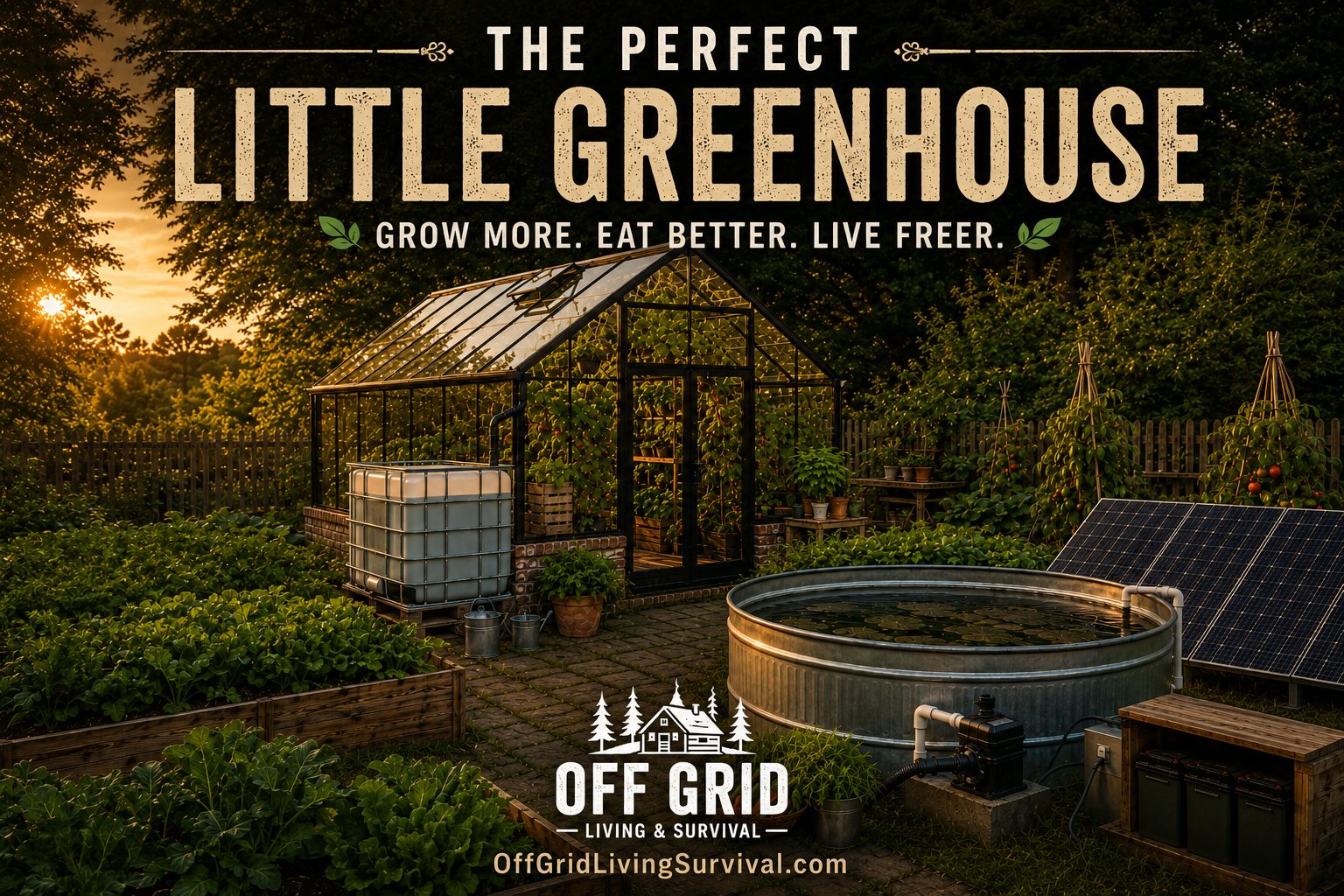
The Perfect Little Food Greenhouse
How to Build a Self-Sufficient Backyard Greenhouse for About $1,400
How to Build a Self-Sufficient Backyard Growing System on a DIY Budget
A greenhouse doesn’t need to cost $5,000 or $10,000. If you already have the land, tools and ability to do the work yourself, you can build a serious 10-by-16-foot food greenhouse for roughly $1,400 in materials.
The key is knowing where to spend money and where not to. For the budget version, we’ll use a durable wood frame covered with UV-resistant greenhouse film. Later, if you want a more permanent structure, the same basic concept can be upgraded to an aluminum-frame, polycarbonate greenhouse.
The goal isn’t just to put plants under plastic. We’re creating a small, self-sufficient food-production system that captures rainwater, irrigates itself by gravity, composts its own organic waste, saves seed and uses sunlight instead of purchased energy wherever possible.
What We’re Building
Our basic greenhouse is 10 feet wide by 16 feet long, giving us 160 square feet of protected growing space. Inside are permanent soil beds, a walkway, vertical trellises and a small seed-starting area.
Instead of ornamental plants, virtually everything in the greenhouse is edible: tomatoes, cucumbers, peppers, beans, peas, strawberries, lettuce, spinach, kale, onions, carrots, herbs and seasonal seedlings for the outdoor garden.
The greenhouse extends the growing season, protects crops from weather and pests, and lets us grow vertically. That means 160 square feet of floor space can support considerably more growing surface than the footprint alone suggests.
The Water System
A 160-square-foot greenhouse roof can collect approximately 100 gallons of water from every inch of rainfall. That comes from the standard approximation of 0.623 gallons per square foot per inch of rain.
Instead of letting that water run onto the ground, gutters send it through a debris screen and first-flush diverter into a food-grade IBC tote.
A 275-gallon tote gives us substantial storage without blowing the budget. A second tote can always be added later.
From there, a gravity-compatible drip system delivers water directly to the beds. A commercial rain-barrel drip kit capable of watering roughly 50 plants currently sells for about $65.
That means the basic irrigation chain is simply:
Rain → roof → gutter → tank → drip line → food.
No municipal water is required when rainfall and storage are adequate, and no electric irrigation pump is necessary if sufficient gravity pressure can be achieved.
Ventilation Without Electricity
Greenhouses can become dangerously hot surprisingly quickly, so ventilation is essential.
For the $1,400 build, we keep it simple: low intake vents, upper vents and a manually operated door. Hot air naturally rises and escapes through the high vents while cooler air enters below.
Build the Soil Instead of Buying It Forever
The growing beds should connect directly with the ground where site conditions permit. That gives roots far more soil volume than containers and eliminates the need to fill dozens of expensive raised beds.
Start with existing soil and improve it with compost, leaves, grass clippings, crop residue and other suitable organic material.
Once the greenhouse is operating, plant waste goes back into the compost pile and eventually returns to the beds.
The objective is a loop:
Plants → food → organic waste → compost → soil → plants.
Purchased fertilizer may occasionally be useful based on soil testing, but bags of fertilizer should not be the system’s foundation.
Save Seed and Grow Vertically
Open-pollinated varieties allow you to save seed from successful crops and reduce another recurring expense.
Vertical trellises dramatically increase the productive capacity of the greenhouse. Tomatoes, cucumbers, pole beans and peas can grow upward rather than consuming valuable floor area.
Lower-growing crops such as lettuce, carrots, radishes and herbs occupy the space beneath and between taller plants.
This is a food greenhouse. Every square foot should have a job.
Version One: The $1,400 DIY Food Greenhouse
The budget version uses a pressure-treated wood structure and UV-resistant 6-mil greenhouse polyethylene.
Greenhouse film is where we save the most money. A current 20-by-100-foot roll of 6-mil UV-resistant greenhouse film sells for about $126.56 and provides substantially more material than this greenhouse requires, leaving material available for repairs or replacement.
Estimated Material List
| Material | Budget |
|---|---|
| Pressure-treated 4×4 posts | $65 |
| Pressure-treated 2×4 framing | $230 |
| 2×6 roof/base framing | $115 |
| Extra lumber for battens, vents and door | $70 |
| Concrete for posts | $75 |
| Structural and exterior screws | $85 |
| 6-mil UV greenhouse film | $127 |
| Door hardware and hinges | $25 |
| Gutters | $40 |
| Downspouts, filter and rain fittings | $45 |
| Used food-grade 275-gallon IBC tote | $125 |
| Gravity-fed drip irrigation | $65 |
| Vent screening/hardware cloth | $35 |
| Trellis wire, cord and supports | $30 |
| Compost/soil amendments | $75 |
| Seeds | $30 |
| Mulch | $25 |
| Miscellaneous plumbing/fittings | $40 |
| Estimated Total | $1,302 |
That gives us roughly $100 of breathing room for local price variation, forgotten fittings and inevitable trips back to the hardware store.
Realistic target: $1,350–$1,400
Current retail examples support the major cost assumptions: 10-foot vinyl gutter sections are around $9.98, greenhouse film around $126.56 per 20×100-foot roll, and gravity-oriented drip systems around $65.
And remember: labor is $0 in this calculation because you are the labor.
Version Two: The Aluminum + Polycarbonate Upgrade
Once the basic concept proves itself, there is a much more permanent option: an aluminum frame with polycarbonate glazing.
For this version, I would not custom-build the aluminum frame from raw extrusion unless there is a specific reason to do so. At this scale, commercially manufactured aluminum greenhouse kits can actually be cheaper than purchasing all the aluminum, fasteners, glazing channels and polycarbonate separately.
Current 10×16 aluminum/polycarbonate greenhouse kits illustrate the range extremely well. Home Depot currently lists multiple 10×16 models from roughly $975 to $1,700, while a heavier Canopia by Palram 10×16 model is around $2,225.
That changes our premium budget considerably from the earlier $3,000-plus estimate.
Aluminum + Polycarbonate Food System
| Material | Budget |
|---|---|
| 10×16 aluminum/polycarbonate greenhouse | $1,500 |
| Anchoring/foundation materials | $125 |
| Gutters/downspout modifications | $50 |
| Food-grade 275-gallon IBC tote | $125 |
| Gravity drip irrigation | $65 |
| First-flush/filter plumbing | $45 |
| Interior growing-bed materials | $100 |
| Compost/soil amendments | $75 |
| Trellis system | $40 |
| Seeds | $30 |
| Miscellaneous fittings/hardware | $75 |
| Estimated Total | $2,230 |
I’d therefore price the realistic premium version at:
Approximately $2,200–$2,500 DIY
—not $3,300.
There are even 10×16 aluminum/polycarbonate kits currently advertised closer to $1,000–$1,400, meaning a careful shopper could potentially build the complete premium food system for under $2,000.
The important caveat is structural quality. A cheap aluminum greenhouse should be properly anchored and may need reinforcement for the wind and snow loads in your area.
Why Polycarbonate Is the Upgrade
Polycarbonate costs dramatically more than polyethylene film, but it gives you rigid walls, greater durability and a much more finished structure.
A typical 6-mm multiwall 4×8 panel is designed for greenhouse applications, has a UV-protected side and is lightweight and impact resistant.
And aluminum is a natural companion material because it does not rot in the constantly humid environment of a greenhouse.
So our two builds now make sense:
Budget greenhouse: about $1,400, wood + greenhouse film.
Permanent upgrade: about $2,200–$2,500, aluminum + polycarbonate.
No bait-and-switch. The greenhouse in the title really can be built for around $1,400.
The Bigger Idea
What makes this project worthwhile isn’t merely having tomatoes a few weeks earlier.
You are building infrastructure.
The roof harvests water. The soil grows food. Crop waste becomes compost. Seeds create next year’s plants. Trellising multiplies productive space. Passive ventilation uses basic physics instead of electricity.
And because you supplied the labor yourself, the materials are essentially the entire capital cost.
For around $1,400, you can build the economical version first, grow food immediately and improve the system over time.
Then, if the greenhouse proves its value, the polycarbonate-and-aluminum version becomes an upgrade—not a surprise hidden halfway through an article titled “Build It for $1,400.”
***
If you really want to get crazy with it, you can add a larger greenhouse and an aquaponics system for about $10k to $15k. This could become an income stream for you. One tank could make you from a few hundred to over $1000+/month. The whole system could pay for itself in about a year.
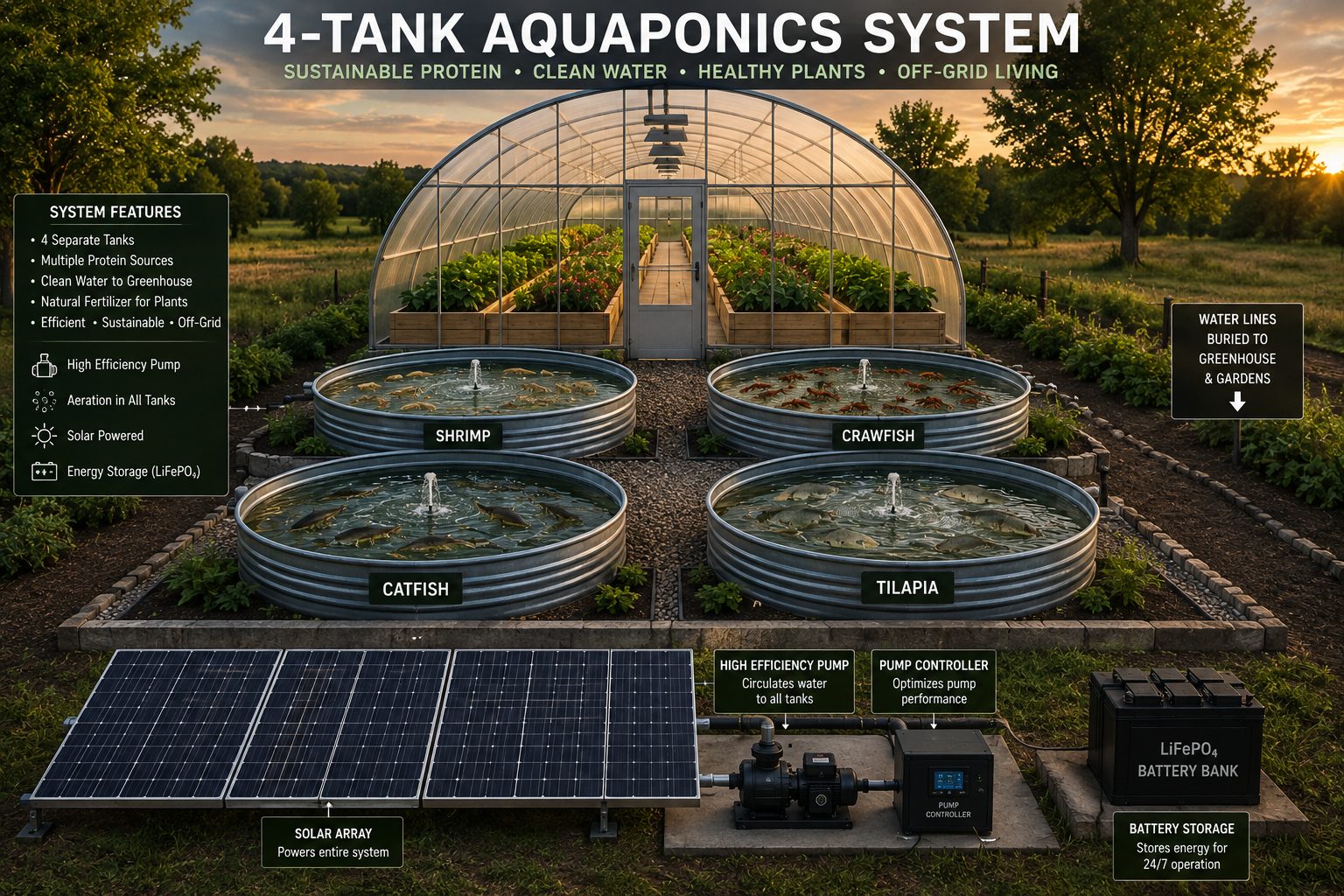
Add Aquaponics: Turn Fish Waste Into Plant Food
Aquaponics combines aquaculture—raising edible fish or freshwater livestock—with plant production. Fish are raised in a tank, such as a galvanized or food-safe lined cattle stock tank, while a small pump moves nutrient-rich water through filtration and into greenhouse grow beds or irrigation zones. Beneficial bacteria convert ammonia from fish waste first into nitrite and then into nitrate, a form of nitrogen that vegetables can readily use. The plants remove much of that dissolved nutrient load, and cleaner water can then return to the fish tank. Done correctly, the result is a remarkably efficient loop: feed the fish, the fish feed the plants, and the plants help clean the water for the fish.
Aquaponic water is especially useful for leafy greens, herbs, tomatoes, cucumbers, peppers, strawberries and many other food crops. It can substantially reduce purchased fertilizer and water consumption because the same water is continually reused. Fruiting crops generally demand more potassium, calcium, iron and other minerals than fish waste alone supplies, so a productive system still needs periodic testing and mineral supplementation. Good filtration, aeration, dissolved oxygen and temperature control are also essential—the livestock are living animals, so this should be treated as a managed ecosystem rather than simply a tank of fertilizer water.
For an off-grid version, a small solar-powered circulation and aeration system backed by LiFePO₄ batteries can keep the water moving day and night. Multiple stock tanks can be installed beside the greenhouse, allowing different species to be raised separately according to their temperature, stocking-density and water-quality requirements.
Good Food Species for Separate Aquaponics Tanks
- Tilapia: Probably the classic warm-water aquaponics fish. Fast growing, hardy and tolerant of relatively intensive systems. Best where water can be kept warm.
- Channel catfish: Excellent food fish, hardy and well suited to larger tanks. They tolerate somewhat cooler conditions than tilapia but still need strong aeration and filtration.
- Bluegill / sunfish: Tough, adaptable and useful for smaller-scale systems. Growth is slower than tilapia, but they work well in many temperate climates.
- Yellow perch: A good cooler-water food fish with excellent table quality. More demanding about water quality than tilapia.
- Rainbow trout: Outstanding for cold-water systems. They grow quickly but require consistently cool, highly oxygenated water and are much less forgiving of system failures.
- Barramundi: A fast-growing warm-water fish with excellent food value, but it requires warmer temperatures and may not be practical or legal everywhere.
- Freshwater prawns: Species such as giant river prawns can provide a high-value second crop. They require hiding structure and careful management because larger individuals can become aggressive or cannibalistic.
- Crayfish / crawfish: Well suited to their own tank or specially designed bottom habitat. They eat a broad range of foods but need shelters because they are territorial and can prey on one another during molting.
A homestead could therefore operate one tilapia tank, one catfish tank and another tank for freshwater prawns or crayfish, rather than trying to mix incompatible species together. That creates several different protein sources while all of the systems contribute nutrient-rich water to the greenhouse and garden.
The important caveat is local law: some fish and crustaceans—especially tilapia, crayfish and non-native species—are restricted in certain states because of invasive-species concerns. Check your state fish-and-wildlife and aquaculture rules before stocking a tank.
In other words, the greenhouse can become more than a vegetable-growing system. Add aquaponics and it begins producing vegetables, fruit, herbs, seedlings, fish and freshwater shellfish from the same integrated water-and-nutrient cycle.
***
Like this article?
Get the my magazine. Subscribe now to download every issue. Your subscription helps me create more off-grid content to share with the world.
MORE INFO: https://www.offgridlivingsurvival.com/magazine


